


Urban Development / Education Reform / Cultural Evolution / Institutional Learning
Designing the Commons
Creating the conditions for cooperation
of Regents Academy students dropped out in the first year, vs 16.4% of the comparison group
Core design principles from Elinor Ostrom's work
Executive Summary
David Sloan Wilson and his collaborators use multilevel selection theory and Elinor Ostrom's core design principles to study what lets groups cooperate. In Binghamton, New York, they mapped prosociality (behavior that benefits others), helped residents design parks, and tested a school for at-risk teenagers in a randomized trial. ProSocial World now trains groups to apply the design principles.
When cooperation breaks down
Groups often fail because what benefits one member can harm the group. The ecologist Garrett Hardin called this the tragedy of the commons: when a resource is open to everyone, each user has a reason to take more, and the resource is used up. Wilson explains why with multilevel selection theory: within a group, selfish members tend to beat cooperative ones, even though groups of cooperators beat selfish groups.
Conventional economic wisdom held that shared resources would be overused unless they were privatized or regulated from outside.
Ostrom's design principles
Elinor Ostrom, who shared the 2009 Nobel Prize in economics, showed that groups can manage shared resources themselves, at least when certain conditions are met. Her cases included communities in Switzerland, Japan and the Philippines that had governed meadows, forests and irrigation water for generations. She identified eight design principles that broadly set the successful groups apart from those that failed.
Applying the principles to other groups
In 2013 Wilson, Ostrom and Michael Cox argued that the principles follow from the way cooperation evolves, and therefore apply to most human groups. Groups of close relatives or proven friends, and groups facing an emergency, often need fewer of them. ProSocial World states the eight principles this way:
1. Clear group identity and shared sense of purpose
2. Equitable distribution of benefits and resources
3. Inclusive decision-making
4. Transparency of behavior
5. Graduated responding to helpful and unhelpful behavior
6. Fast and fair conflict resolution
7. Autonomy and authority to put principles 1–6 into practice
8. Appropriate relations with other groups, consistent with principles 1–7
Studying cooperation across a whole city
In 2006 Wilson and colleagues started the Binghamton Neighborhood Project to study prosociality across a small, economically depressed city. They planned to repeat a survey every three years, map the results by neighborhood, and test controlled interventions to increase prosociality.
Mapping prosociality
1. A city-wide survey
In 2006 the team and the school district surveyed 1,942 students in grades 6–12. The survey, Search Institute's 58-item Developmental Assets Profile, asked students about themselves and the support around them. The answers were then mapped to where each student lived.
2. A check against behavior
In 2007, Binghamton University students dropped 216 stamped, addressed letters on sidewalks around the city. Letters dropped in neighborhoods with below-median support scores had about 60% lower odds of being mailed than letters dropped in neighborhoods above the median. When support was analyzed as a continuous score instead, the link was not statistically significant.
3. Social support and prosociality
Students who reported more social support, especially from several sources, scored higher on prosociality. Once social support was taken into account, neighborhood income had no significant direct link to prosociality.
Wilson, Daniel Tumminelli O'Brien and Arturo Sesma called these correlations preliminary. They wrote that identifying the causes would require "studying cultural evolution in action." The park competition was one attempt to do that, by changing conditions directly.
The Design Your Own Park competition
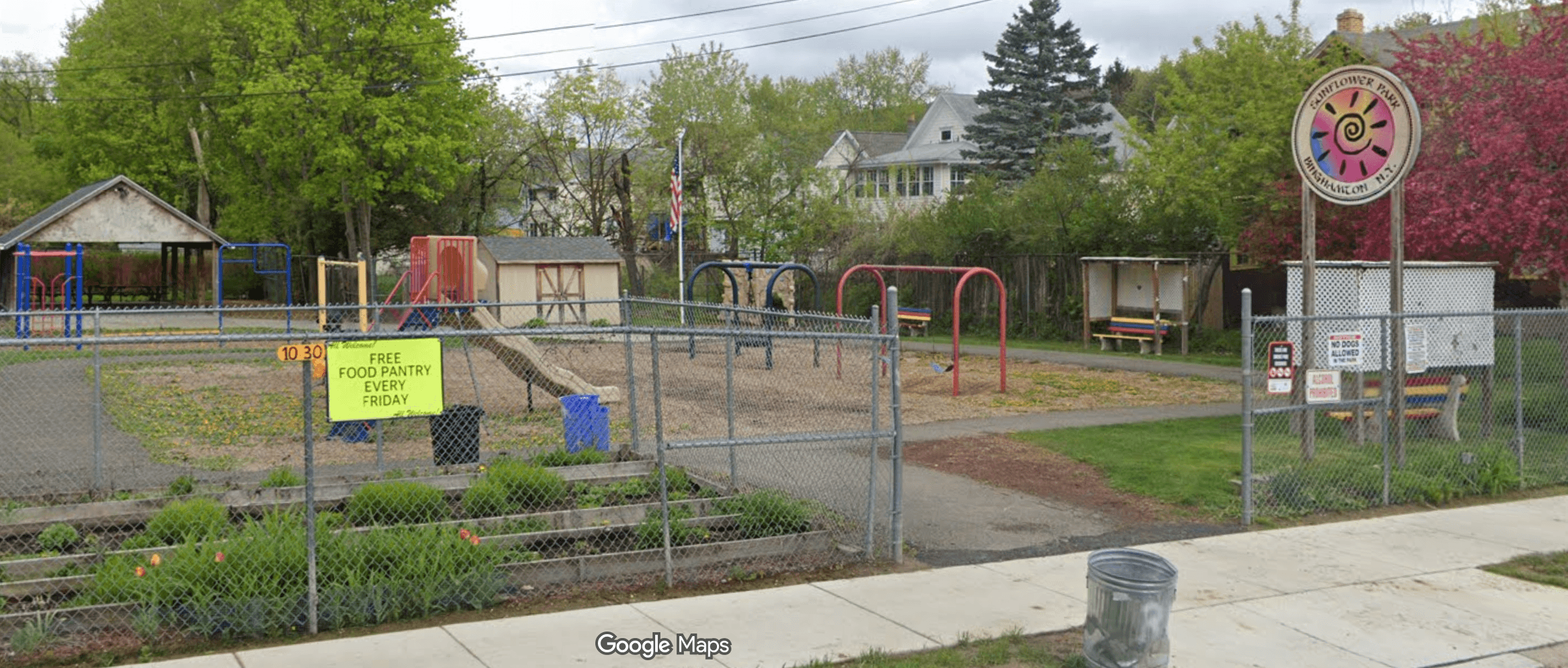
Residents were to design the parks and build them with help from Binghamton University faculty and students. Five projects started in the first year.
The competition soon expanded beyond neighborhood parks. A high-school student proposed a BMX park, dog owners wanted a dog park, and a resident of one of the city's toughest areas proposed turning an intersection into a community space.
The rules were designed to keep the competition friendly. Every plan rated excellent would be funded if money allowed, the competition would run again, and groups could freely borrow one another's ideas. Wilson described it as "a managed process of cultural evolution." In practice, groups worked at their own pace, and the chance to improve their neighborhood motivated them more than competing did.
The organizers expected groups to maintain their own parks as much as possible. Wilson wrote that this would save the city maintenance costs and keep neighbors in contact. In 2011 he judged it too early to assess the competition fully.
The Regents Academy for at-risk students
In 2010 the Binghamton City School District opened the Regents Academy for 9th and 10th graders who had failed at least three of five courses the year before. Raising such students' performance often calls for a longer school day, a longer year and other expensive measures. The Academy kept the normal day and year, and cost slightly more per student than the regular high school.
A school designed for cooperation and learning
Wilson and his graduate student Richard Kauffman Jr. designed the Academy's social environment with its principal, Miriam Purdy, and four teachers. They drew on Ostrom's principles, on research into how young people adapt to harsh environments, and on learning theory. The Academy had its own staff and location, and its design included:
a strong group identity
a safe, caring environment
short-term rewards for cooperating and learning
a say for students in the school's norms and practices
The researchers evaluated the first year with a randomized trial. Of the 117 students who qualified, 56 were chosen at random to attend, and the other 61 stayed at Binghamton High School as a comparison group. The trial tested the program as a whole and could not separate the effects of its parts.
First-year results
Who's behind it


How it's used now
Wilson later wrote that he and Kauffman withdrew from the Regents Academy when they judged it no longer had the autonomy to govern its own affairs. It closed the following year. Wilson calls this an example of “the paradox of programs that work but don’t survive or spread”: even a program that works can be undone by the next school superintendent, mayor or dean.
In 2019, Wilson, Atkins and the psychologist Steven C. Hayes set out the ProSocial Process in their book Prosocial. The process pairs the core design principles with tools from acceptance and commitment therapy, such as the ACT Matrix. ProSocial World says these tools help "balance mindfulness with purposeful action."
Public sector
In 2016–17 Robert Styles, now with ProSocial World, coached the leaders of a division of Australia's Department of Finance. The division had been formed by merging two others, and its head said that on the day they merged, the "Hunger Games began!" The leaders then ran workshops with their teams. Staff census scores were higher afterward than before on measures including engagement and leadership.
Training facilitators
ProSocial World trains experienced facilitators through its Leading ProSocial course, where Paul Atkins is one of the coaches. It also runs ProSocial Action Labs for established teams.
Nonprofits and communities
In San Antonio, Texas, ProSocial World and local leaders studied what helps community groups keep collaborating. In Latin America, Styles facilitated the first phase of a project with the Brazilian group CollabSoul, which then adapted the process to connect education, conservation and social service groups.
Cooperation depends on conditions
In the Regents Academy paper, Wilson and his co-authors call humans "facultative cooperators", whose cooperation depends on circumstances. Under the wrong conditions, they write, "cooperation becomes as difficult as if we had the wrong genes." Under the right ones, "it becomes difficult to prevent people from cooperating."
David Sloan Wilson
Writing in Evonomics, 2016
Published by Center for Human Progress (US) Inc., a 501(c)(3) organization