


Cultural Evolution / Governance / Institutional Learning
Reducing Political Hostility Through Cooperation
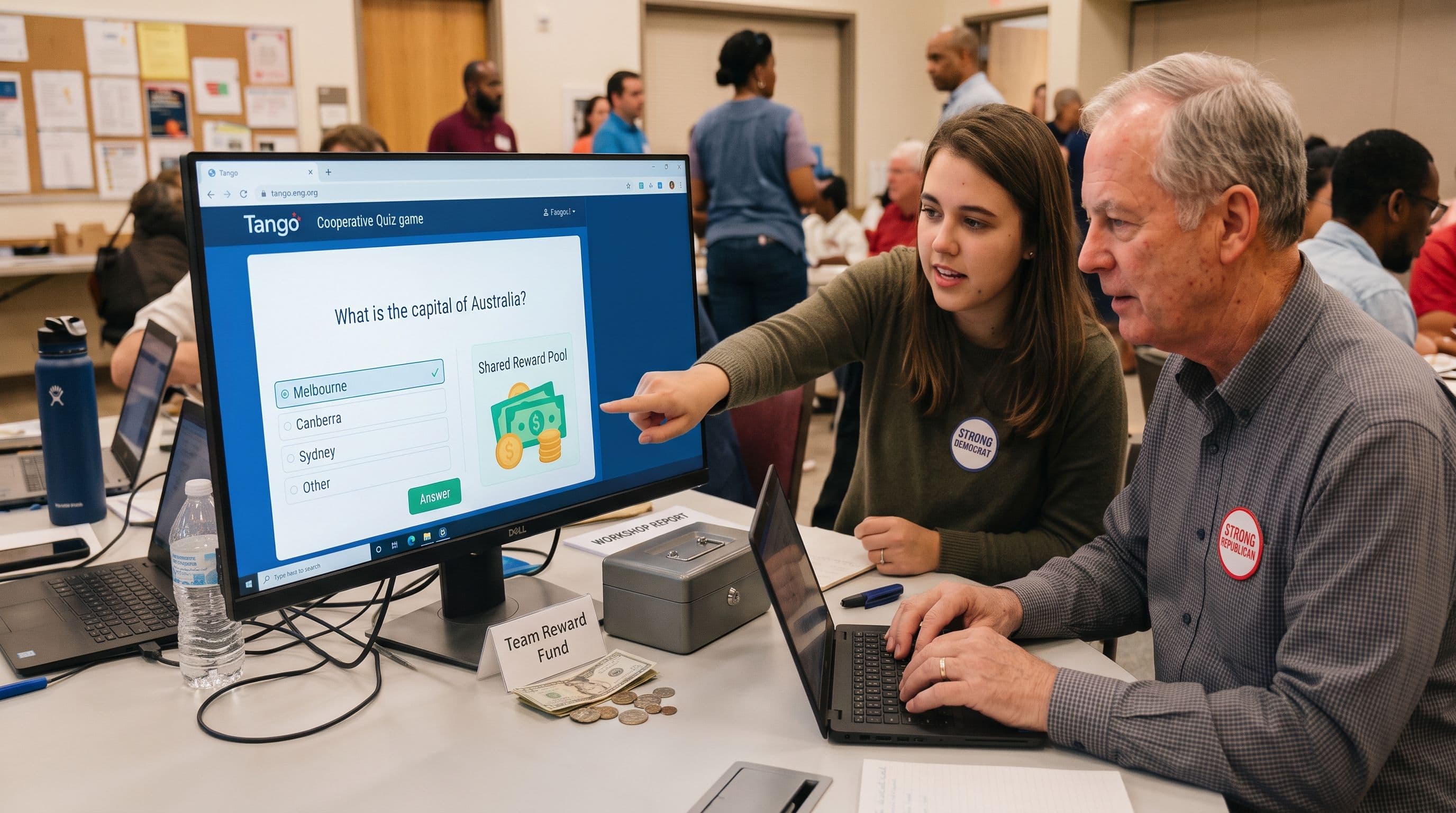
A cooperative online quiz game that pairs Democrats and Republicans as teammates
0US participants across five experiments
0Hour of play in a single session
0Months that some effects lasted after one game
Executive Summary
Democrats and Republicans who spent an hour as teammates with someone from the other party reported warmer feelings toward that party, and some effects lasted up to four months. The pairs played Tango, a cooperative online quiz game. Lucas Woodley, Evan DeFilippis and colleagues in Joshua Greene's lab at Harvard ran these experiments online with US participants. Anyone can now join weekly public Tango games, and by mid-2025 the team was piloting the game in Israel.
Who's behind this
Joshua Greene is the Alfred and Rebecca Lin Professor of Civil Discourse and Professor of Psychology at Harvard University. He is an experimental psychologist, neuroscientist and philosopher who studies moral judgment and decision-making. His book Moral Tribes: Emotion, Reason, and the Gap Between Us and Them (2013) asks how groups with different values can get along. He later said the book was "very philosophical and offered little practical guidance for real-world problem-solving." His lab now builds and tests practical tools for reducing conflict between groups.

Key terms
Why partisan hostility is hard to reduce
Democrats and Republicans increasingly dislike and distrust each other. Greene's team wanted to ease that hostility online, including among people unlikely to sign up for cross-party dialogue.
A widening gap
From 1978 to 2020, the gap between how warmly Americans feel toward their own party and toward the other party grew by 29 points on a 0 to 100 scale. The figure comes from American National Election Studies data cited by the Tango authors.
The motivational challenge
Structured dialogue in person can reduce partisan hostility for months. It is hard to run at scale. Online interventions are easier to scale, but many people, especially strong partisans, aren't motivated to take part. Psychologists Alexander Landry and Eran Halperin call this the "motivational challenge."
How the game works
Partners chat in real time and agree on each answer together. In the experiments, both earned a bonus of 5 to 15 cents for each correct answer. The authors hypothesize that players warm to the other party when they see their partner as someone who helps them succeed. The hypothesis depends on perceived help, not on whether the partner actually raises the pair's score. The studies were not designed to fully isolate this mechanism.
The Tango experiments
Greene's team ran five randomized experiments with Tango between 2018 and 2024 and preregistered four of them, recording their hypotheses and analysis plans in advance. All participants were in the US and identified mainly as Democrats or Republicans. They were recruited through the online survey platforms CloudResearch and Prolific. The main comparison was between cross-party and same-party pairs.
Which parts of the game mattered
Only the two-player game, played with a live partner from the other party, had statistically significant effects on warmth and giving toward the other party. A chat with no quiz and a one-player version of the game did not.
| Row | What players did | Result, compared with a same-party partner |
|---|---|---|
| Chat only (Experiment 1) | A five-minute get-to-know-you chat with a partner from the other party, with no quiz | No significant difference in warmth toward the other party |
| One-player game (Experiment 4) | The quiz played alone, with answers from an earlier player of the other party | No significant difference in the main measures of warmth or giving |
| Two-player game (Experiments 1 to 3, and 5) | The quiz played in real time with a partner from the other party, with or without political questions | Warmer feelings toward the other party in all four experiments, and more giving to its members in the three that measured giving |
What the results suggest
The authors think games like Tango might reach people with no interest in cross-party dialogue. None of the players had been recruited for such an interest, and players from both parties rated the game highly enjoyable. The authors caution that the participants were experienced survey takers who may differ from the wider public, and that all the experiments were in the US. Greene values constructive dialogue. He says it depends on "that basic sense of mutual respect and openness," of thinking "this person is on my team."
Joshua Greene
Alfred and Rebecca Lin Professor of Civil Discourse and Professor of Psychology
Next steps for Tango
Greene and Scott Warren of the Global Development Incubator led a Templeton World Charity Foundation project (2023 to 2026) to test the game with new populations.
1. Other countries
The project set out to test the game in India and Israel. By mid-2025 a pilot was underway in Israel, and the team was writing questions for India and Northern Ireland.
2. The public
The project also planned to test the game in everyday online settings in the US, including with people who hold extreme political views. Anyone can join the weekly public games at letstango.org. Each lasts 15 minutes, compared with an hour in the experiments.
3. Campuses and workplaces
By mid-2025 the team had run Tango with thousands of undergraduates on US campuses and had finished a first trial with employees of a Fortune 500 company. The researchers also want to test whether repeated play makes the effects last longer or become larger.
Published by Center for Human Progress (US) Inc., a 501(c)(3) organization